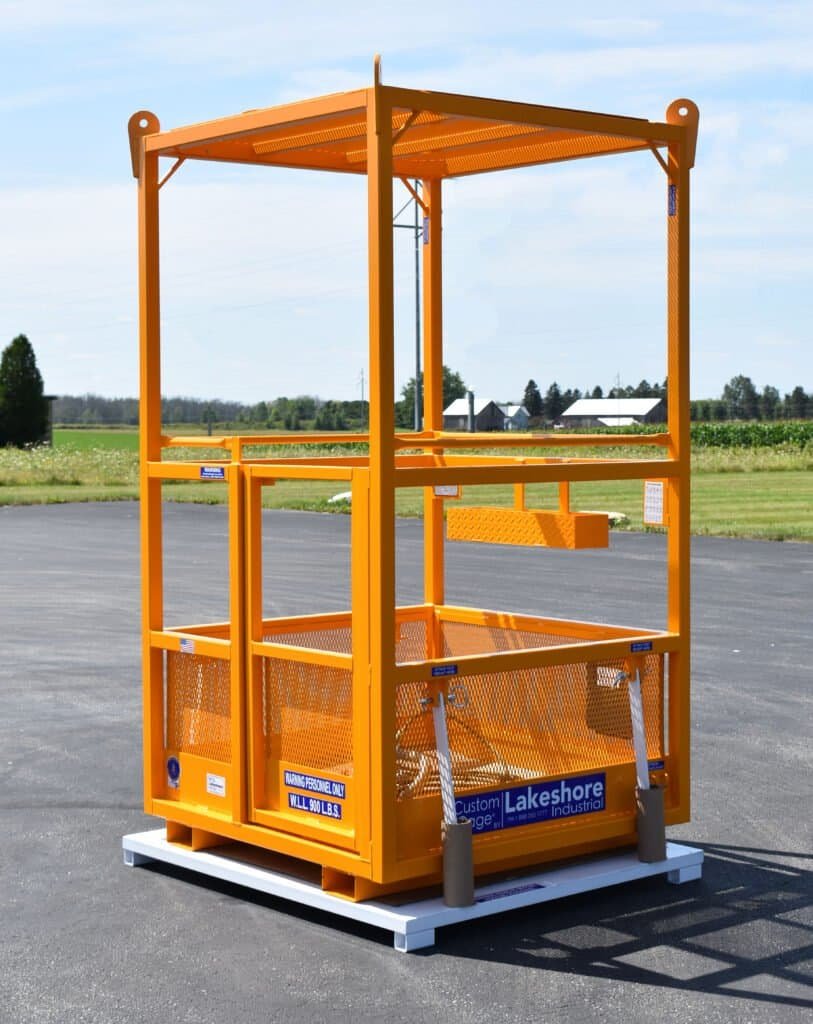
The safety factor for lifting personnel in the U.S. is 5:1, meaning OSHA requires a man basket and its rigging to support at least five times the maximum intended load without failure. In Canada, CSA Z150 raises the rigging requirement to 10:1. That is the short answer. The longer answer is where a lot of crews get tripped up, because the safety factor changes depending on which piece of the system you are talking about: the platform, the bridle, the crane’s hoist line, or rotation resistant rope.
This is a question we hear a lot at Lakeshore Industrial, especially from contractors bidding work on both sides of the border. In this blog we will break down what a safety factor actually is, compare the numbers side by side for OSHA, ASME and CSA, and walk through how to figure out what your rigging needs to be rated for. This blog will be referencing OSHA 29 CFR 1926.1431, ASME B30.23 and CSA Z150.
What is a safety factor?
A safety factor (you will also see it called a design factor) is the ratio between what a piece of equipment can hold before it fails and what it is actually allowed to lift. Put simply, it is the margin built in between “working load” and “breaking point.”
Here is how that looks in real numbers. Say your total lifted load is 2,000 lbs.
- At a 5:1 safety factor, the system must be able to support 10,000 lbs. without failure.
- At a 10:1 safety factor, the system must be able to support 20,000 lbs. without failure.
One thing we want to be very clear on: a 5:1 safety factor does not mean you can load a basket to five times its rating. The safety factor is a design requirement for the manufacturer, not extra capacity for the jobsite. The rated capacity on the basket’s data plate is the number you never go over.
Safety factor for lifting personnel by standard
The platform itself is built to 5:1 under U.S. rules, and the rigging is where the U.S. and Canada split: 5:1 versus 10:1. Here is how each standard lines up, piece by piece.
| Component | OSHA 1926.1431 (U.S.) | ASME B30.23 | Canada (CSA Z150 / provincial) |
|---|---|---|---|
| Personnel platform structure | 5:1 designed by a qualified person | 5:1, designed by a qualified person | 5:1 Engineered Stamped drawing required |
| Bridle, shackles, master links, wire rope rigging | Capable of supporting 5x the intended load plus the weight of the basket itself | Built and marked per B30.23; each bridle leg marked with its rated load | 10:1 with a secondary means of support (5 part bridle) |
| Rotation resistant rope | 10:1 | 10:1 | 10:1 |
| Crane hoist (load) line | 7:1 | 7:1 | Per CSA Z150 and crane manufacturer |
| Crane capacity | Total load can’t exceed 50% of rated capacity at the given radius | 50% | Treated as a critical lift in most provinces; follow your lift plan |
| Proof test | 125% of rated capacity, held 5 minutes, at each new jobsite | 125% of rated capacity, held 5 minutes, at each new jobsite | 125% of rated capacity, held 5 minutes, at each new jobsite |
The big takeaway: if your crew works in Canada, your bridle needs to be rated for twice what OSHA asks for. A basket that is rigged perfectly legal in Michigan may not be legal in Ontario.
5:1 vs 10:1: why does Canada require more?
Canada simply takes a more conservative approach to anything that holds a person in the air. Under CSA Z150 section 6.4.8, the rigging used to hoist a personnel platform must support 10 times the total load. That means a 2,000 lb. lift needs a bridle rated for 20,000 lbs., where OSHA would only require 10,000 lbs.
You will see the same 10x thinking in provincial rules too. Ontario’s construction regulation (O. Reg. 213/91, s. 137(8)) requires every part of the hoisting and rigging system on a suspended platform to support ten times its maximum load, and WorkSafeBC sets a design factor of at least 10 for any rigging assembly used to support workers.
So which one should you follow? Our answer is always the same: if there is any chance the basket crosses the border, rig it to 10:1. A 10:1 bridle meets OSHA and CSA. A 5:1 bridle only meets OSHA. When lifting people it is always best to follow the stricter of the regulations, and the cost difference in a heavier bridle is nothing compared to a failed inspection or worse.
Safety factor for lifting equipment vs. lifting personnel
Personnel lifting always carries a higher safety factor than material lifting. That makes sense when you think about it. If a load of steel pipe drops, you lose material. If a man basket drops, you could lose a life.
Here is how general lifting equipment and lifting devices compare:
| Equipment | Typical minimum safety factor | Standard |
|---|---|---|
| Wire rope sling (material) | 5:1 | ASME B30.9 / WorkSafeBC Table 15-1 |
| Alloy steel chain sling | 4:1 | ASME B30.9 / WorkSafeBC Table 15-1 |
| Below-the-hook lifting device, Design Category A | 2:1 | ASME BTH-1 |
| Below-the-hook lifting device, Design Category B | 3:1 | ASME BTH-1 |
| Personnel platform and rigging (U.S.) | 5:1 | OSHA 1926.1431 |
| Personnel rigging (Canada) | 10:1 | CSA Z150 |
This is also why OSHA says a bridle used on a man basket can only be used for the personnel platform (1926.1431(g)(5)). Bridles are tagged specifically for personnel or material use. If your crew is lifting large amounts of material, a dedicated material basket with its own rigging is the way to go. Our material baskets fall under ASME B30.20 and are load tested at 125% of capacity.
How to calculate what your rigging needs to be rated for
Now, let’s put the numbers to work. Say you have a crane man basket rated for 1,000 lbs. with a net weight of 800 lbs. Both numbers should be on the basket’s data plate.
- Find your total lifted load. Rated capacity + net weight of the basket = 1,000 + 800 = 1,800 lbs.
- Apply your safety factor. Under OSHA (5:1), the rigging must support 1,800 x 5 = 9,000 lbs. Under CSA Z150 (10:1), it must support 1,800 x 10 = 18,000 lbs.
- Account for the sling angle. The lower the angle of the bridle legs, the more tension each leg sees. At a 60 degree angle each leg carries about 15% more than it would hanging straight down. OSHA requires bridle lift angles to be no less than 45 degrees. At Lakeshore Industrial we typically shoot for 60.
- Check the crane. Add the hook, load line and rigging to your 1,800 lbs. If that comes to 2,100 lbs., the crane needs to be rated for at least 4,200 lbs. at the radius you plan to lift, because the total can’t exceed 50% of rated capacity.
This math should be part of your lift plan before anyone steps into the basket.
3 safety factor mistakes we see on jobsites
Treating the safety factor as extra capacity. We touched on this earlier but it is worth saying again. The 5:1 is built in so the basket never fails at its rated load. It is not permission to put five guys in a two-man basket.
Forgetting about rotation resistant rope. If the crane is running rotation resistant rope, the hoist line safety factor jumps from 7:1 to 10:1, even in the U.S. This one gets missed more than you would think.
Swapping rigging between material and personnel lifts. A bridle that has been used to hoist material can’t be put back on a man basket. Keep your personnel rigging tagged, marked and dedicated to the basket it was built for.
FAQ
What is the safety factor for lifting personnel? In the U.S., OSHA 1926.1431 requires a minimum 5:1 safety factor for the personnel platform and its rigging. In Canada, CSA Z150 requires 10:1 for personnel rigging.
Is a 10:1 safety factor required for man baskets in the U.S.? Not for the basket or bridle. OSHA only requires 10:1 when the crane uses rotation resistant rope. That said, rigging to 10:1 keeps you compliant in both countries.
What is the difference between a safety factor and a design factor? In rigging, the terms are used the same way. Both describe the ratio between breaking strength and the working load limit.
What safety factor is required for the crane’s hoist line when lifting personnel? OSHA requires the load line to support at least 7 times the maximum intended load, or 10 times when rotation resistant rope is used.
How is a man basket tested before use? OSHA requires a proof test at 125% of the basket’s rated capacity, held for at least 5 minutes, each time the basket is brought to a new jobsite. Every Lakeshore Industrial man basket is also tested at 200% of its rated capacity before it leaves our shop.
Safety factors for lifting personnel at a glance
- Personnel platform structure: 5:1 (OSHA and ASME)
- Bridle and rigging hardware: 5:1 in the U.S., 10:1 in Canada
- Rotation resistant rope: 10:1 everywhere
- Crane hoist line: 7:1
- Total load: never more than 50% of the crane’s rated capacity
- Proof test: 125% of rated capacity at each new jobsite
Lifting people is a dangerous act, and the safety factor is one of the most important numbers to get right. Getting it right starts with the manufacturer. Lakeshore Industrial has been building OSHA and ASME compliant man baskets and personnel platforms since 1998, and every basket we build is tested at 200% of its rated capacity before it ships. Whether your crew is working in the U.S., Canada or both, we can build and rig a basket to meet the standard you need.
Give us a call at 888-265-1777 or request a quote here. We would love to find a solution to fit your needs.