

Some operations plan for elevated access as part of daily work. Others encounter it only when overhead equipment needs repair. In facilities like warehouses and manufacturing plants, issues such as failed lighting can create the need for safe access at height.
Man baskets, also called personnel lifting baskets, are used in these situations to provide workers with access to elevated work areas. Two of the most commonly used types are crane man baskets and forklift man baskets, though they have different uses. Selecting the correct platform supports worker safety and helps maintain compliance with OSHA requirements.
What Are Crane Baskets and Forklift Platforms?
Crane man baskets and forklift man baskets perform the same basic task. The difference lies in how they are built and where they are intended to operate. Space constraints, working height, and surface conditions play a role in determining which platform is appropriate.
Crane Man Baskets
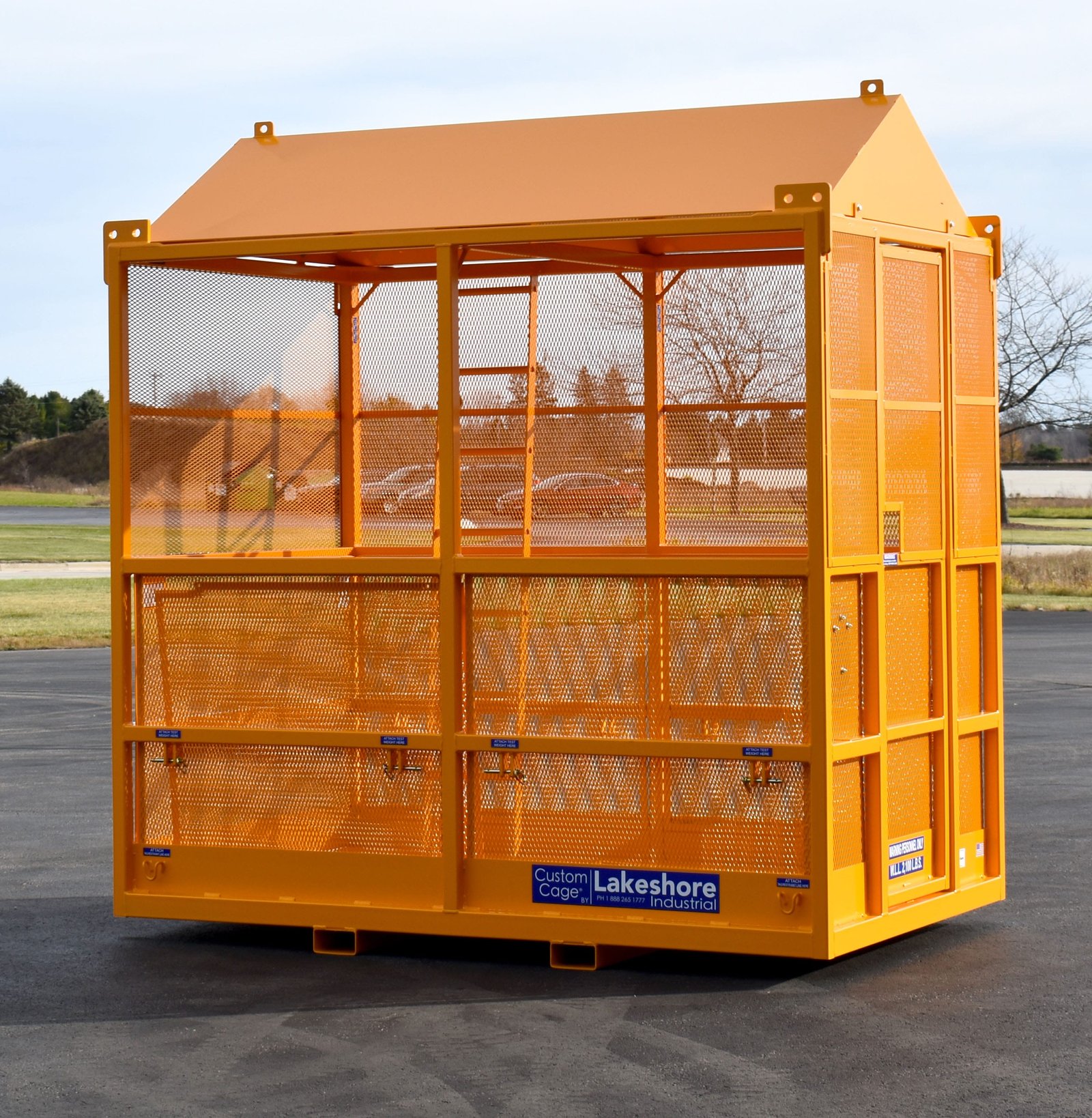
A crane man basket is suspended from a crane using rated lifting lugs and certified rigging. The basket includes guardrails, reinforced welds, non-slip flooring, and anchor points for fall protection. These features keep the platform stable and secure while work is performed at height or in locations that are difficult to access from the ground.
Crane baskets are used on projects where height or site conditions limit the use of other access equipment, such as:
- Construction
- Servicing of utilities
- Infrastructure repair
- Industrial maintenance
Forklift Man Baskets
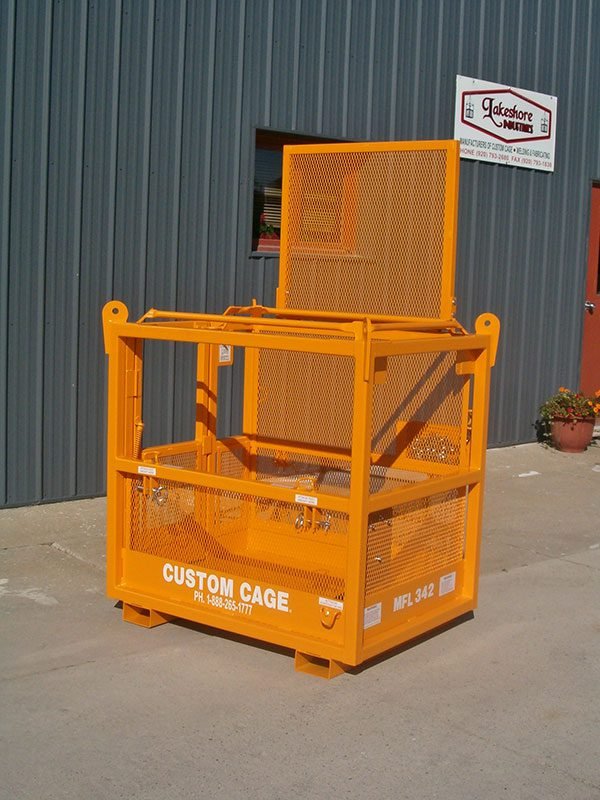
A forklift man basket attaches to the tines of a forklift or telehandler using locking pins or retention sleeves. The platform relies on the forklift mast for elevation and the machine’s steering for positioning. Reinforced frames and slip-resistant floors help keep the basket stable while in use.
Forklift work platforms are typically used in warehouses, manufacturing facilities, and distribution centers. Their mobility and simple setup make them a practical option for indoor tasks that require overhead access.
Outdoor Use of Forklift Work Platforms: A Note on Safety and Compliance
While forklift man baskets are generally intended for controlled environments, they may be suitable for limited outdoor tasks. However, such applications come with safety considerations beyond standard indoor forklift practices.
Operating on unimproved or natural terrain introduces different stability factors and equipment requirements. In these conditions, ANSI/ITSDF B56.6, the safety standard for rough-terrain forklift trucks, applies.
This standard addresses issues such as machine stability, surface conditions, and safe operation on uneven ground. Reviewing manufacturer instructions and applicable standards is essential before using a forklift-mounted platform in outdoor environments.

Advantages and Limitations of Crane Baskets
Advantages
A crane basket provides access to elevated areas on outdoor job sites where ground-based equipment is not practical. Crews can be positioned along bridge spans, near tower structures, or in locations that extend beyond stable ground access. The crane’s boom makes this positioning possible, while outriggers help maintain stability on soil or unfinished surfaces.
Many models are built with reinforced floors and rated anchorage points, which accommodate heavier tools and equipment as well as more workers.
Limitations
A crane basket requires space for crane setup and maneuvering, which limits its use in confined or obstructed areas. Indoor work is usually not feasible due to lower ceilings and floor loading restrictions.
A qualified crane operator is required, along with a pre-lift inspection before use. These requirements add time to deployment, which is why crane baskets are typically used on outdoor or large-scale projects where reach and site layout support crane operation.
Advantages and Limitations of Forklift Man Baskets
Advantages
Forklift man baskets work well in controlled indoor environments. Because forklifts can move through narrow aisles and position the platform directly under the work area, they are often preferred for work at height in warehouses, production facilities, and distribution centers.
Setup is generally quick. Facilities that already use forklifts can attach a personnel platform without bringing in additional equipment. For lighting replacement, overhead inspections, or targeted maintenance, a forklift man basket can be positioned quickly with minimal delays or disruption to operations.
Limitations
The working height of a forklift platform is limited by the mast. The forklift must remain on a firm, level surface to maintain balance, which restricts use to finished flooring. This means they are not suited for uneven terrain commonly found in outdoor construction environments.
Additionally, forklift man baskets are intended for smaller crews and lighter tools. A forklift-mounted man basket typically can only hold one or two people, depending on the size of its platform and the capacity of the forklift itself. Indoors, the total weight of the basket and its occupants cannot exceed 50% of the forklift’s capacity.
Crane Basket vs. Forklift Man Basket: At-a-Glance Comparison
| Criteria | Crane Man Basket | Forklift Man Basket |
| Primary environment | Outdoor work on large, open sites | Indoor facilities and warehouses |
| Height capability | Reaches elevated areas beyond ground-based equipment | Limited by forklift mast |
| Mobility and positioning | Crane movement allows access over obstacles | Forklift steering supports tight spaces |
| Terrain requirements | Stabilized on uneven ground with outriggers | Requires firm, level flooring |
| Crew capacity | Supports more personnel and heavier tools | Suited for one or two workers |
| Setup time | Requires crane positioning and rigging | Quick deployment with compatible forklifts |
| Clearance needs | Requires space for boom movement | Works in low-clearance areas |
| Common applications | Utility repair, structural work, outdoor projects | Facility maintenance and indoor repairs |
Key Safety and Regulatory Considerations
OSHA standards apply to both crane-suspended personnel platforms and forklift work platforms, while ASME standards apply only to crane-suspended personnel baskets.
Crane-suspended platforms must comply with OSHA rules for personnel handling. These include:
- Visible rated capacity tags
- Approved fall protection anchor points
- Guardrail construction
- Proof-load testing
The crane must remain stable during operation, and all rigging components must match the rated load.
Forklift platforms follow a separate set of OSHA requirements. The platform must lock securely to the forks and remain stable throughout mast movement. OSHA also requires an engineered design with reinforced framing and retention systems that prevent disengagement. Forklift operation must stay on level ground, and sudden movements should be avoided.
Using equipment that meets these requirements supports safe operation and simplifies compliance during inspections.
When To Use a Crane Basket vs. a Forklift Platform
Whether a crane basket or a forklift work platform is best for your project depends on various factors, from site conditions to the height it needs to reach.
High-Reach Outdoor Projects: Crane Basket
Crane baskets are often used for tower maintenance, bridge inspections, and structural repairs at height. The crane’s boom allows workers to reach areas that mobile lifts cannot access. Outriggers help stabilize the crane on soil or unfinished ground.
Indoor or Tight-Aisle Maintenance: Forklift Platform
Forklift platforms are better suited for work inside finished facilities. They move easily through narrow aisles, allowing workers to position themselves directly below the task area. Lighting replacement and overhead equipment maintenance are typical applications.
Crew Size and Task Scope
Tasks involving multiple workers or heavier tools tend to require crane basket use. Smaller maintenance jobs handled by one or two technicians are usually better suited to a forklift platform.
Terrain and Floor Conditions
Cranes can stabilize on uneven surfaces, making crane baskets suitable for construction sites. On the other hand, forklift platforms require a smooth, level floor.
Custom Personnel Lifting Baskets by Lakeshore Industrial
Evaluating height requirements, site conditions, and the type of work involved helps determine which platform is best suited for the job site. Verifying OSHA and ASME compliance further supports worker safety and helps operators meet documentation needs.
Lakeshore Industrial manufactures OSHA- and ASME-compliant man baskets and work platforms for industrial and construction applications. Our crane baskets and forklift platforms feature reinforced frames, non-slip floors, secure anchorage points, and load-tested components.
We work with contractors, facility managers, and maintenance teams to help select equipment that fits job site conditions and operational needs. Whether the work involves outdoor access or indoor maintenance, our team can provide guidance on the appropriate platform.
If you are evaluating man baskets for an upcoming project, reach out to Lakeshore Industrial. We can discuss your requirements and find the ideal solution for your personnel lifting basket needs.