

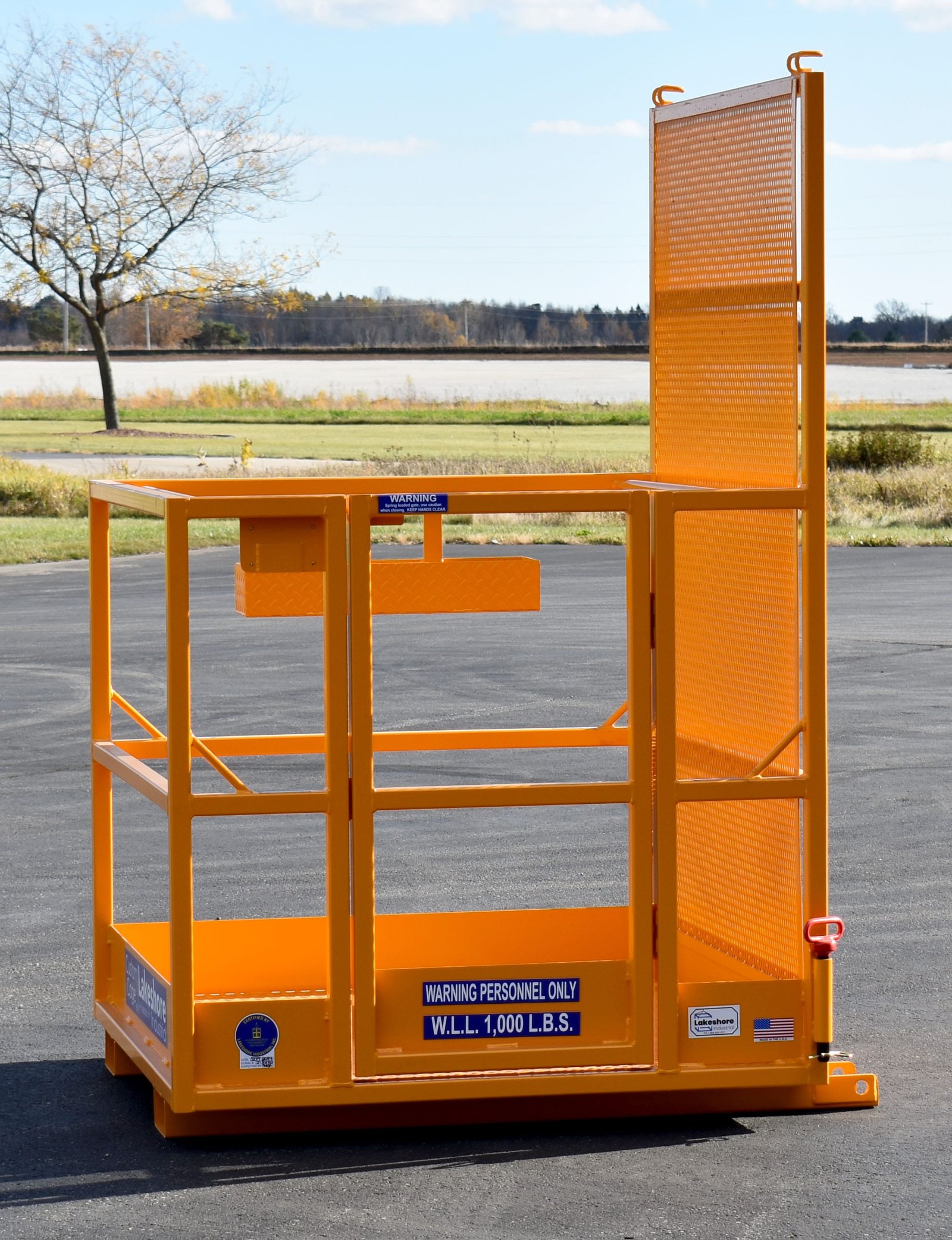
The question warehouses and industrial companies often face is how to safely elevate employees with a forklift. Yes, you can lift workers with a forklift, but only on a purpose-built work platform that is attached to the truck, rated for the load and used by trained operators. A loose pallet or a homemade box puts your crew and your OSHA record at risk.
This guide covers what an OSHA compliant forklift work platform needs, how much weight it can carry, and what to check before every lift.
Are man baskets allowed on a forklift?
Yes, with conditions. OSHA does not ban lifting people with a forklift, but it expects a platform designed for the purpose and fitted to the truck. Three conditions come up repeatedly in OSHA’s interpretation letters:
- The truck is approved for it. In construction, forklifts may support a work platform only if the manufacturer designed them for that use (29 CFR 1926.451(c)(2)(iv)). If the manual forbids it, you can’t do it. If the manual does not say, confirm with the manufacturer or get written certification from a professional engineer.
- The platform is a real attachment. OSHA treats work platforms as removable attachments. They should carry a nameplate showing serial number, weight and capacity, and the truck-and-platform combination may be rated lower than the platform alone.
- Nothing safer will do. For rough-terrain forklifts, OSHA says to consider scaffolds, scissor lifts, aerial lifts or ladders first and use the forklift only when those are not practical.
OSHA’s training rule applies too. Under 29 CFR 1910.178(l), employers must make sure forklift operators are competent, shown through training and an evaluation of their work in the workplace.
What must an OSHA compliant forklift work platform be equipped with?
A compliant platform is built to protect the worker inside. Make sure your basket has the following:
| Feature | What to look for |
| Guardrails | Top rail 39 to 45 inches above the floor, with a midrail below it |
| Toeboard | At least 3.5 inches tall, so tools and debris stay on the platform |
| Protective back | Expanded-metal back that keeps workers clear of the mast and carriage: 5 feet minimum in most places, 7 feet in California |
| Gate | Self-closing gate that cannot swing open by accident |
| Fall protection tie-off | Lanyard anchor points, such as bars on the lower rail |
| Secure attachment | Fork pockets with heavy-duty pins set behind the heel of the forks, plus cotter pins or safety chain attachment |
| Data plate | Permanent marking of rated capacity, empty weight and serial number |
| Width | No more than 10 inches wider than the outside of the wheels on each side, unless outriggers are used |
| Construction | Sound welds by a qualified welder, ground-smooth edges and a slip-resistant floor |
Lakeshore builds forklift platforms to ASME B56.1 and the fall protection requirements of OSHA 29 CFR 1926.502 (Subpart M). Telehandler platforms skip the protective back because they don’t work against the moving mast parts of a forklift.
How much weight can a forklift work platform hold?
Forklift work platforms are rated based on the amount of personnel being lifted plus their tools to do the job. The first person must be rated for 300 lbs. and every subsequent person after to 250 lbs. Manufacturers may then give some wiggle room and rate the platform higher than it needs to be.
For rough-terrain forklifts and telehandlers, AEM’s work platform checklist, which follows ANSI/ITSDF B56.6, caps the combined weight of platform, load and people at one-third of the capacity on the load chart. Confirm the exact limit for your truck with its manufacturer.
Secure tools and materials and spread them evenly across the floor so the platform stays balanced. Lakeshore load-tests its man baskets at 200% of rated capacity before they leave our Two Rivers, Wisconsin shop.
Forklift platform safety rules for operators
A compliant platform only protects people when the lift is run correctly.
- Use only trained, evaluated operators.
- Before raising anyone, set the travel controls to neutral, apply the parking brake and keep the mast vertical.
- Keep a trained operator in the seat, within reach of the controls.
- Never drive the truck with the platform raised or with anyone on it.
- Warn workers before raising or lowering, and move slowly and smoothly. Never tilt the platform while it is elevated.
- Have workers wear a full-body harness and tie off to the platform’s anchor points.
- Check the path for power lines, overhead obstructions and storage racks, and mark the work area so others know elevated work is underway.
- Do not modify the platform unless the manufacturer approves.
Pre-lift inspection checklist
Run through this before every lift. Print it and keep it with the platform.
- ☐ Tubing, welds and floor plate show no cracks, dents, distortion, sharp edges, rust or corrosion
- ☐ Guardrails, midrail and toeboard are intact
- ☐ Gate closes and latches on its own
- ☐ Lanyard tie-off bars are secure
- ☐ Fork pockets are undamaged, and pins and cotter pins are in place
- ☐ Data plate is legible
- ☐ Platform is centered on the truck and secured to the carriage
- ☐ Ground is firm and level, and the overhead is clear
- ☐ Everyone on the lift has been briefed
Forklift platform vs. crane basket vs. aerial lift
Forklift platform options are not interchangeable. Pick the one that fits the height, reach and rules of the job.
| Option | Best for | Watch for |
| Forklift or telehandler platform | Warehouses, plants and job sites where a truck is already on hand | Truck approval, derated capacity, no driving with workers aboard |
| Crane man basket | Heights and reach beyond a forklift | Trial lift, 125% proof test, crane loads capped at 50% of rated capacity, wind limits |
| Aerial lift or scissor lift | Routine elevated work with a purpose-built machine | Rental or purchase cost, ground and access limits |
Not sure which fits? Our comparison of crane baskets and forklift platforms walks through the trade-offs, and our telehandler platform guide covers reach.
Forklift work platform FAQs
Are forklift man baskets OSHA approved? OSHA does not approve or certify individual products. What matters is that the platform is designed to the applicable standards (ASME B56.1 and OSHA’s fall protection rules). Make sure your platform has safety lanyard hook ups, a legible data plate, self latching and inward swinging gate, and is secured to your forklift.
Does a forklift work platform need a trial lift? OSHA does not require trial lifts for forklift mounted baskets, however a pre lift inspection is always a good idea and best practice.
Can the forklift drive with workers on the platform? No. Park the truck, set the brake and keep the mast vertical before raising anyone, and never drive with the platform raised or occupied.
Can I order a custom size? Yes. Lakeshore builds custom forklift and telehandler platforms. Send us your truck details and we will size one to fit.
Get a forklift work platform quote
Lakeshore Industrial has built man baskets, material cages and work platforms in Two Rivers, Wisconsin since 1998, and our man basket platforms carry a three-year warranty. Tell us about your lift needs and we will recommend a platform that is built to OSHA standards.
Request a quote or call 1-888-265-1777. You can also browse our forklift work platforms and review our OSHA regulations page.
Sources
- OSHA letter on forklifts in construction: elevating personnel and operator training (Sept 30, 1999)
- OSHA letter on work platforms as attachments (Aug 15, 2013)
- AEM: Elevating personnel with work platforms checklist
