

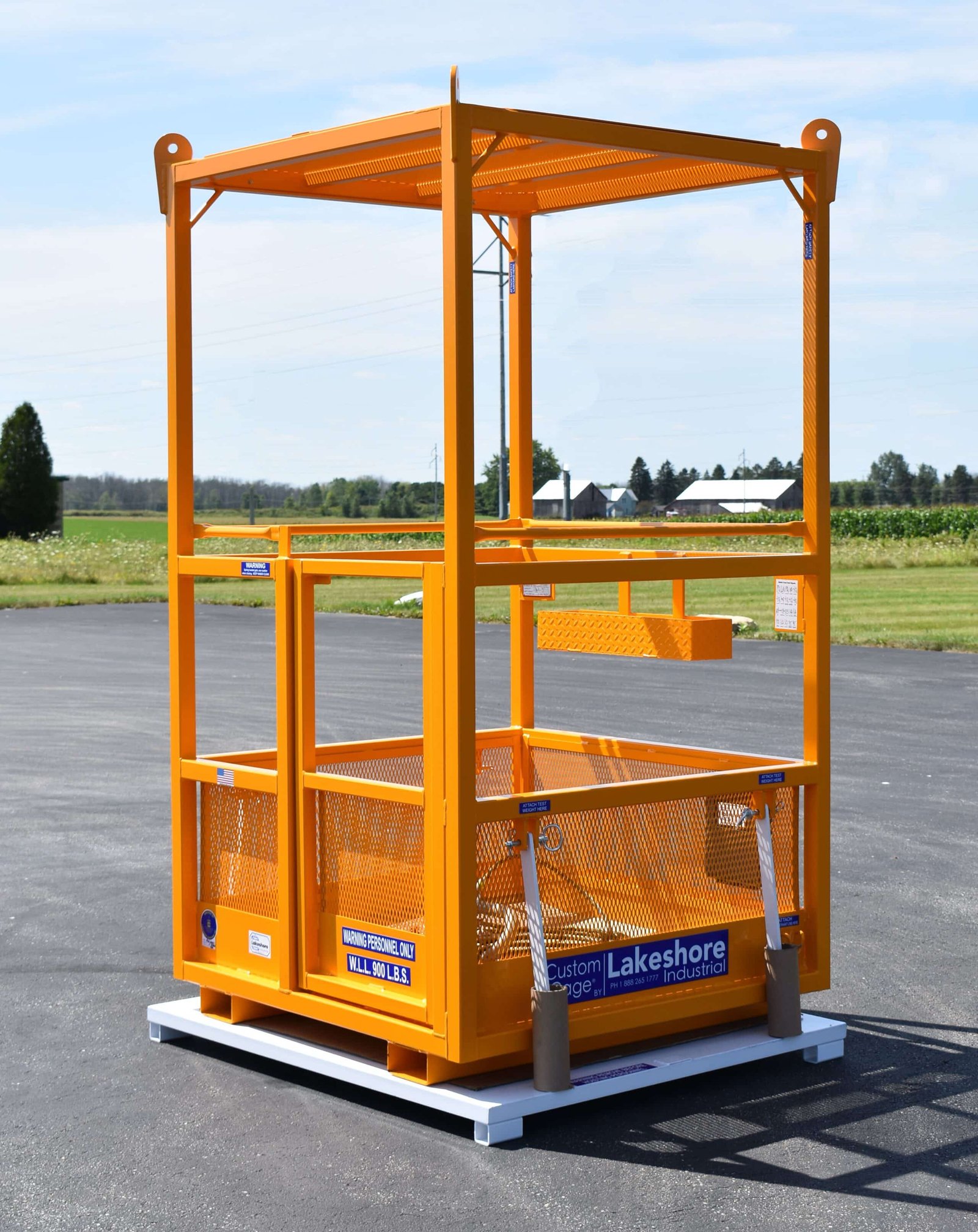
Man baskets solve access problems quickly, but they compress significant risk into a small footprint: suspended load, elevated workers, tight tolerances and a chain of decisions that must all align. If you oversee crane man basket operations, the fastest way to reduce exposure is to target repeatable failure points: the violations that surface repeatedly during audits, incident reviews and jobsite stop-work orders.
These seven violations represent the most persistent compliance gaps, anchored to the Occupational Safety and Health Administration’s (OSHA’s) construction requirements for hoisting personnel and standard operating practices for crane-suspended platforms.
Violation #1: Operating Without Proper Fall Protection
Treating the guardrail as the sole fall protection ignores the most predictable hazard in crane man basket safety: unexpected movement, a swing, or a loss of balance during positioning.
OSHA’s hoisting-personnel standard requires workers in a personnel platform to use a personal fall arrest system in compliance with OSHA 29 CFR 1926.502 subpart M, in most cases, with specific exceptions addressed in separate interpretations. Anchorage matters. Clipping to a convenient point, such as an adjacent structure, a hook, or a rail, rather than to an approved anchorage within the platform system, creates preventable risk.
What To Do Instead:
- Verify every occupant has a properly fitted harness and compatible connectors.
- Require tie-off to an approved anchorage point designed to sustain fall arrest loads (this point should be clearly labeled).
- Enforce “clip-in before movement” through pre-lift checklists.
Violation #2: Exceeding Rated Load Capacity
This violation often happens unintentionally. A grinder gets added, then a chainfall, then a box of fittings. A heavier worker swaps in. The “light lift” is no longer light.
OSHA’s rule on crane man basket safety is explicit: the total load, including platform, rigging, hook, load line, tools, materials and personnel, must not exceed 50 percent of the rated capacity for the radius and configuration in use, except during proof testing.
What To Do Instead:
- Calculate lifts like rigging plans: platform weight plus rigging, hook block, tools, materials and personnel.
- Confirm crane configuration and actual radius, then verify chart capacity at that radius.
- Limit tools to what will be used at elevation.
Violation #3: Using Non-Certified or Poorly Built Baskets
A homemade basket or modified platform lacking engineering controls is both a compliance problem and a structural risk. The basket is a load-bearing structure that must behave predictably under dynamic crane motion.
OSHA requires that a qualified person familiar with structural design engineer the personnel platform and suspension system. The platform must support its own weight plus at least five times the maximum intended load. Weight and rated capacity must be permanently posted.
What To Do Instead:
- Use purpose-built platforms with permanent data plates showing weight and rated capacity.
- Confirm guardrail design, toe boards and openings meet platform criteria.
- Verify the gates latch and cannot swing outward unintentionally.
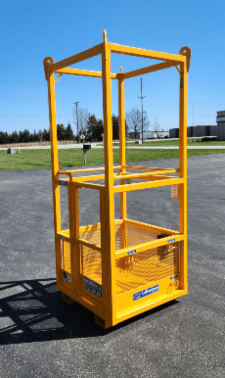
Violation #4: Improper Rigging and Attachment
Rigging failures in man basket lifts are rarely dramatic. More often, they stem from “small” mistakes: a hook that is not secured, a mismatched bridle leg, a connection allowing the platform to tilt, or hardware never intended for personnel lifting.
OSHA’s platform criteria require the connection system to keep the platform within 10 degrees of level, regardless of boom angle, and to minimize tipping from occupant movement. Hooks must close and stay closed. Hardware must be properly configured and rated.
What To Do Instead:
- Use rigging purpose-selected for personnel platform service with compatible hardware.
- Ensure bridle and suspension systems distribute load evenly.
- Reject field modifications to sling lengths or connections; stop and correct rigging that does not fit.
Violation #5: Lack of Pre-Lift Inspection and Trial Lifts
Putting people on the platform first and “testing as you go” reverses the sequence OSHA expects and increases the chance that problems are discovered only after exposure exists.
OSHA requires a trial lift and post-trial visual inspection by a competent person to confirm equipment, ground conditions and platform behavior. Proof testing to 125% of rated capacity is required at each jobsite before hoisting employees and after repair or modification. The load must be held for at least five minutes under controlled conditions.
What To Do Instead:
- Run trial lifts from the entry point to each work position with the platform unoccupied.
- Inspect immediately after the trial lift for defects, interference, instability or imbalance.
- Proof test to the required level and document the test, load used and acceptance decision.
Violation #6: Working in Unsafe Environmental Conditions
Jobsites normalize marginal conditions: wind that “isn’t that bad,” power lines that “are far enough,” a surface that “looks stable,” or weather moving in “after this last pick.” These conditions turn controlled lifts into reactive ones.
OSHA requires a stable setup. The platform must be uniformly level within one percent and positioned on a footing a qualified person deems firm and stable. Standard practice includes using tag lines when necessary, maintaining controlled movement and discontinuing hoisting when the weather becomes dangerous.
What To Do Instead:
- Set clear stop-work thresholds for wind (over 20 mph), lightning and visibility before the lift starts.
- Confirm setup surface, outrigger deployment and level condition meet requirements.
- Control unintended movement with tag lines and slow, deliberate lifts.
Violation #7: Inadequate Training for Operators and Personnel
A man basket lift is a coordinated personnel-hoisting operation with defined roles: operator, signal person, competent person, qualified person and platform occupants. When training is thin, teams substitute habit for procedure, and habit varies.
OSHA’s work-practice requirements include constraints platform occupants often violate when not briefed: keeping the body inside the platform during movement, not standing on rails to gain height, not pulling the platform out of plumb and maintaining operator presence at controls.
What To Do Instead:
- Conduct pre-lift meetings covering route, communication method, emergency plan, load calculations and role assignments.
- Train platform occupants on movement rules: inside the rails, no climbing, no side-loading the platform.
- Require competent-person signoff for trial lift, proof test and inspection steps.
Build Compliance Into the Equipment Decision
If you want to pressure-test your current program against OSHA man basket requirements, use these seven violations as your audit framework: fall protection, capacity, platform integrity, rigging, trial and proof steps, environmental controls and role-based training. When those seven stay locked down, your personnel-hoisting plan stops relying on careful operators and starts relying on repeatable controls.
And if you want your equipment to match that standard, start with a man basket built for the real world, not a workaround. Lakeshore Industrial manufactures and supplies high-quality man baskets designed for demanding industrial and construction environments. We offer robust 2″ square tube construction, clear capacity identification and fit and finish that support compliance.
Contact Lakeshore Industrial today to discuss your personnel platform requirements and discover how the right equipment choice supports both operational efficiency and regulatory compliance.