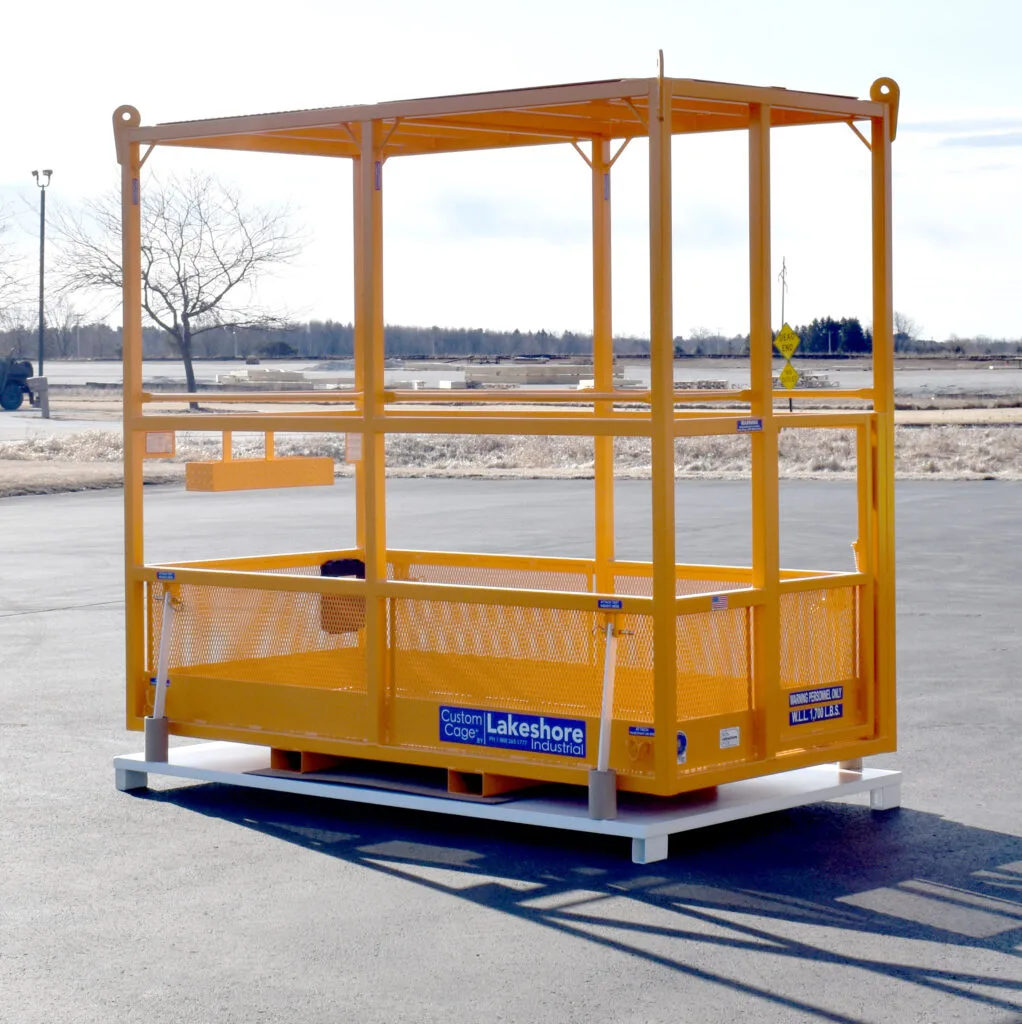
Following OSHA regulations for man baskets is critical to worker safety. Despite the importance of following all OSHA regulations some manufacturers still miss the small details. That is what this blog will dive into, the little known facts that manufacturers and operators must be aware of to maintain the utmost safety when working with personnel platforms. This blog will be referencing ASME B30.23 and OSHA 29 CFR, Part 1926.1431 subpart CC.
OSHA Man basket wind resistance requirements
Perhaps the most common place where manufacturers will fall short in their designs is accommodating for wind resistance. Crane man baskets are required to be wind resistant up to 20 mph of wind. When wind is greater than 20 mph OSHA requires a qualified person to determine whether or not conditions remain safe to continue elevated work.
How should manufacturers design platforms to be wind resistant?
Answer: expanded metal rather than solid steel where enclosure is necessary, like up to the mid rail as required in 1926.1431(e)(6).
Total lifted load of the crane must not exceed 50% of its rated capacity:
Perhaps one of the most common causes of accidents when using a crane is overloading. When hoisting personnel this mistake can be deadly.
The total lifted amount of the crane when hoisting personnel must not exceed 50% of the crane’s rated capacity at the given radius. It is critical for a qualified team to design a lift plan prior to using a man basket. This lift plan should reference the crane’s load chart to note the capacity at the radius planned to lift.
To factor in the total amount of weight lifted when using a crane man basket use the baskets rated capacity plus the overall net weight of the basket, both of which should be found on a data plate resistant to deterioration.
A Crane Man Basket must remain within 10 degrees of level at all times.
This OSHA regulation applies to all personnel platforms including cantilever man baskets. Cantilever baskets must utilize a special system to keep the basket within 10 degrees even when operators are working out on the deck of the platform. For the experts at Lakeshore Industrial this means using specialized rigging and a heavy counter weight at the rear of the basket.
Keeping a man basket at or near level helps prevent slipping and falling which could potentially lead to injury. There are also ways of preventing falls which manufacturers should also include in their basket designs including, slip resistant diamond plate or grated flooring and harness tie off points.
All OSHA Man Baskets must have a minimum guardrail height of 39” and a maximum of 45”
A slightly common request that we get when building custom man baskets is to make the guardrail height shorter. There will be many instances of needing to get a man basket, often a forklift or telehandler basket, into a tight space with a low overhang. In this instance customers will ask if we can lower the height of the guardrails to fit into the space. Every time we have to say no. According to ASME B30.23 section 23-1.1 the top guardrail must be no less than 39” and no more than 45” in relation to the floor of the basket.
This range may limit some jobs but it is absolutely necessary to avoid falling out of the man basket. In addition to these height requirements there must also be a toe board that is a minimum of 3.5” in height and a barrier from toe board to intermediate rail.
When is it acceptable to lift material in a man basket?
Man baskets are of course meant for lifting personnel. But is it ever acceptable to lift material? The answer is yes and no. According to 1926.1431(f)(2)(i) of OSHA standards regarding man baskets, it is only acceptable to lift personnel and their tools or materials absolutely necessary to do the job. This means if you try to hoist workers in a man basket along with some piping or heavy steel, you may run into some trouble with OSHA.
What you would be allowed to do however is carry the small tools like hammers, welders, etc. as long as they remain secured and evenly distributed. Evenly distributed means spreading the weight across the platform floor. This goes back to number 3, keeping the platform within 10 degrees of level at all times, as well as not overloading the capacity.
When on a job that requires lifting large amounts of material, particular heavy material, operators would be better suited to utilize a material basket. Material baskets are specifically designed to transport materials and have their own set of guidelines to follow.
A trial lift must be performed every time the crane changes location
Yes, OSHA generally requires a trial lift every time the crane moves to a new job location. Even if only 10 feet, you are technically required to do a new trial lift. This may sound extreme but many things can happen when a crane moves including displacement of the crane’s balance, the swinging of the man basket or possible loose connections with rigging. This is why when lifting personnel it is always best to follow even the most extreme of the regulations. For more on trial loads we cover everything in our blog “The Role of Trial Loads in Meeting OSHA Standards for Man Basket Operations”.
Lifting people is a dangerous act. An OSHA man basket will make this feat infinitely safer than alternative methods but only if all OSHA regulations and ASME regulations are followed by both the manufacturer and the operating crew utilizing the basket.
Requirements of an OSHA Man Basket
- Be wind resistant up to 20 mph
- Never exceed 50% of the crane capacity
- Remain within 10 degrees of level at all times
- Have a guardrail height between 39” and 45”
- Only lift tools and material necessary to do the job
- Perform trial lifts whenever the crane is moved
Lakeshore Industrial manufactures and sells only OSHA certified man baskets and personnel platforms. Our man baskets are built to exceed OSHA 1926.1431 and ASME B30.23 regulations. This is why we have been trusted for over 25 years to keep crews safe when lifting to extreme heights. If you’re looking to upgrade to an OSHA compliant jobsite to keep your crew safe, give us a call. We would love to find a solution to fit your needs.